
Understanding certificate 3.1 and EN 12588 in lead sheet quality
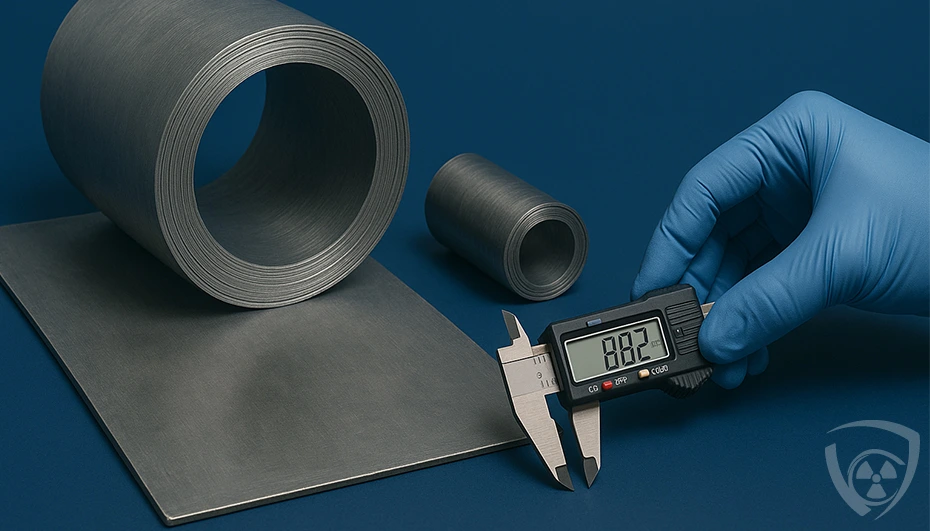
Lead sheets and foils are key materials used in radiological protection, industry, construction, and other fields where a barrier against ionizing radiation is essential. However, the effectiveness and safety of their use depend not only on material thickness but also on quality, chemical purity, and compliance with applicable standards. In this context, having a certificate 3.1 according to PN-EN 10204 and product conformity with EN 12588 plays a crucial role. In this article, we will look at what these documents mean and why it is important to pay attention to them when making a purchase.
What is certificate 3.1 according to PN-EN 10204?
Certificate 3.1 – definition and use
Certificate 3.1 (Inspection Certificate 3.1) is a document issued by the manufacturer based on internal testing and quality analysis of the material. It complies with the European standard PN-EN 10204 and confirms that the product has been manufactured in accordance with the technical requirements specified in the order and meets the relevant quality standards.
What does certificate 3.1 include?
This document includes:
- customer information,
- document number and date of issue,
- order and delivery details,
- chemical composition of the material (elemental analysis),
- compliance with applicable standards (e.g., EN 12588),
- information on lead thickness and grade.
Why is certificate 3.1 important?
- ensures quality and consistency – the product meets customer requirements,
- allows verification of chemical purity – essential in radiological protection,
- serves as a basis for further certification and technical approvals,
- builds customer trust in the manufacturer – providing documentation with full chemical composition and compliance demonstrates transparency and professionalism.
EN 12588 – quality standard for lead sheets and foils
What is EN 12588?
EN 12588 is a European standard that defines the requirements for cold-rolled lead sheets. It is also applied to lead foils.
This standard focuses primarily on:
- lead purity,
- thickness and dimensional tolerances,
- material homogeneity,
- surface structure.
Key Parameters According to EN 12588
The EN 12588 standard requires that:
- the content of pure lead (Pb) is at least 99.81%,
- the content of other elements (e.g., Sn, Cu, Bi, Sb, Ni, Fe) is limited,
- sheets and foils have an appropriate surface structure – free from cracks, inclusions, and other defects.
Example from a Coradika certificate – lead sheet Pb99.94Cu
Coradika supplies lead sheets and foils in accordance with the EN 12588 standard and issues Certificate 3.1 documents.
Sample certificate includes:
Chemical composition (according to EN 12588):
- Pb – 99.94% (requirement: min. 99.81%)
- Sn (tin) – 0.0053% (max. 0.05%)
- Bi (bismuth) – 0.053% (max. 0.10%)
- Cu (copper) – 0.053% (max. 0.08%)
- Other elements such as Ni, Sb, As, Zn, Ag – in trace amounts.
Additional technical information:
- lead grade: Pb99.94Cu
- basis: manufacturer’s analysis
- reference standard: EN 12588
- document type: Certificate 3.1 according to PN-EN 10204
The importance of standards and certification in radiological protection
Products intended for radiological protection, such as lead sheets and foils, must meet strict requirements.
Using uncertified material can result in:
- insufficient protection against radiation,
- rejection during technical inspections in medical facilities,
- health risks for patients and staff,
- non-compliance with legal regulations and sanitary authority requirements.
Thanks to documents such as certificate 3.1 and compliance with EN 12588, the user can be assured that the material:
- was produced according to the required technology,
- is safe and consistent in quality,
- can be used in both medical and industrial environments.
What documents should a reliable supplier provide?
List of required documents:
- Certificate 3.1 according to PN-EN 10204
- Compliance with EN 12588 (e.g., indicated in the chemical analysis)
- Declaration of conformity / technical data sheet
- CE certificates (if applicable)
Customer recommendations:
- Always request proper documentation
- Verify the lead content
Why does Coradika follow the highest standards?
Coradika not only supplies products in compliance with applicable standards but also ensures the quality and transparency of all documentation.
As a result, customers can be confident that they receive material that is:
- compliant with European standards,
- accompanied by complete chemical analysis and technical specifications,
- delivered with an individual Certificate 3.1 for each batch,
- ready for use in medical, industrial, or construction environments.
Summary
In the world of radiological protection, there is no room for compromise on quality. Certificate 3.1 and the EN 12588 standard are not just formalities – they are concrete proof that a lead sheet or foil meets high standards for purity, structure, and protective performance. By choosing products from Coradika, you can be confident that the materials you use are not only effective but also safe and compliant with regulations. Don’t take risks – choose certified solutions for radiological protection.